The Greek Cities of America: A Guide to Greek-American Communities
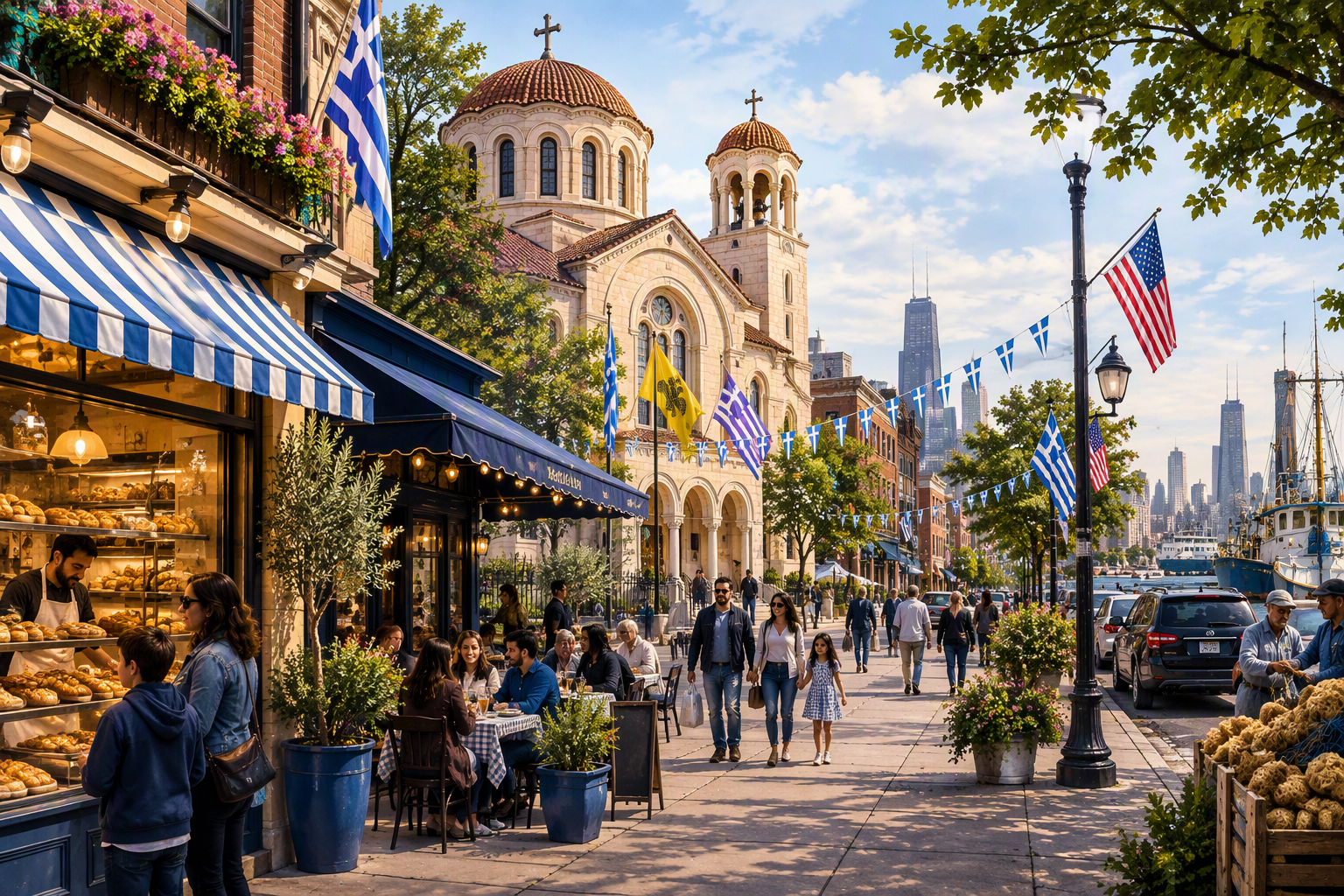
The Greek Cities of America: A Guide to Greek-American Communities
Greek America has never been limited to one city. It developed through a network of urban neighborhoods, suburban communities, coastal settlements, churches, businesses, restaurants, schools, festivals, and family associations.
When people speak of the “Greek cities” of America, they usually mean places where Greek immigrants and their descendants created a visible community life. These centers were not founded exclusively by Greeks, but Greek institutions helped shape their neighborhoods and local culture.
What Makes a City Greek-American?
A Greek-American city or neighborhood usually has several features: a Greek Orthodox parish, family businesses, restaurants and bakeries, cultural associations, Greek-language education, community festivals, and networks connecting families from the same island, village, or region.
Some communities began with industrial work. Others developed around restaurants, maritime industries, commercial districts, universities, or postwar professional migration. Their size and visibility changed over time, but the institutions often remained important even when families moved to the suburbs.
New York City and Astoria
New York has long been one of the most important centers of Greek life in the United States. Astoria became especially associated with Greek immigrants, restaurants, cafés, shops, churches, and community organizations.
The neighborhood connected newcomers to work, housing, relatives, and familiar language. It also served as a meeting point for people from different parts of Greece. Over time, rising rents, suburbanization, intermarriage, and economic change altered the neighborhood, but Astoria remained an important symbol of Greek New York.
Chicago and Greektown
Chicago attracted Greek immigrants through industrial work, commerce, restaurants, and the city’s expanding urban economy. Greek institutions developed alongside the city’s broader immigrant neighborhoods.
The Greek Orthodox community organized one of Chicago’s earliest Greek parishes in 1892, and the Annunciation Greek Orthodox Cathedral was built in 1910. Greektown became a recognizable center of Greek businesses and community life, while Greek Americans also settled in other parts of the metropolitan area.
Chicago’s Greek history shows how a neighborhood can serve as a first home for immigrants and later become a cultural landmark after many families move elsewhere.
Boston and New England
Boston and the surrounding New England region became important destinations for Greek immigrants working in factories, restaurants, small businesses, and commercial trades. Cities such as Lowell and nearby industrial communities developed Greek churches, associations, and family networks.
New England Greek communities often maintained close ties between parishes, regional organizations, and family businesses. Their history reflects both early twentieth-century labor migration and later professional and suburban growth.
Tarpon Springs, Florida
Tarpon Springs has a distinctive place in Greek-American history because of its connection to the sponge industry. Greek and Greek-American sponge divers, boat owners, merchants, and workers helped build a community shaped by maritime knowledge and Mediterranean traditions.
The city’s Greek identity remains visible through its waterfront history, restaurants, celebrations, churches, and cultural heritage. Tarpon Springs demonstrates that Greek America developed not only in large industrial cities but also in specialized coastal economies.
Detroit, Cleveland, Philadelphia, and Baltimore
Industrial cities across the Midwest and Northeast attracted Greek immigrants seeking work and opportunity. Detroit’s manufacturing economy, Cleveland’s industrial base, Philadelphia’s commercial life, and Baltimore’s port and service industries each supported Greek settlement.
In these cities, churches and mutual-aid societies were often the foundation of community organization. They helped immigrants find work, receive assistance, educate children, celebrate religious holidays, and maintain relationships with relatives in Greece.
Los Angeles and San Francisco
Greek communities on the West Coast developed through several waves of migration. Earlier arrivals established businesses and parishes, while postwar newcomers and professionals expanded Greek life in California.
Los Angeles and San Francisco also show how Greek America adapted to a more dispersed metropolitan model. Community life could be organized through a parish or festival even when Greek families lived across a wide area.
Greek Neighborhoods After 1960
After 1960, suburbanization and changing economic patterns transformed many historic Greek districts. Families moved to larger homes, new employment centers, and suburban school systems. Some traditional neighborhoods declined as commercial centers, while churches, festivals, restaurants, and cultural organizations continued to preserve community connections.
Greek-American identity also became more diverse. Some families remained closely connected to Greek language and customs, while others expressed their heritage through food, religion, family history, philanthropy, and annual cultural events.
A Network, Not a Single Place
The Greek cities of America are best understood as a national network. Astoria, Chicago, Boston, Tarpon Springs, Detroit, Cleveland, Philadelphia, Baltimore, Los Angeles, San Francisco, and many smaller communities each tell a different part of the story.
Together, they show how Greek immigrants turned unfamiliar cities into places where language, faith, family, business, and memory could survive across generations.
Sources and Further Reading
- Encyclopedia of Chicago, entries on Greek Orthodox institutions and Chicago’s immigrant communities.
- Library of Congress materials on immigrant neighborhoods and Greek-American history.
- Local Greek Orthodox diocesan, parish, and community archives.
Which Greek-American city shaped your family? Share the city, neighborhood, parish, or business that is part of your family’s American story.