How Many Greeks Live in America? The Greek-American Population Since 1840
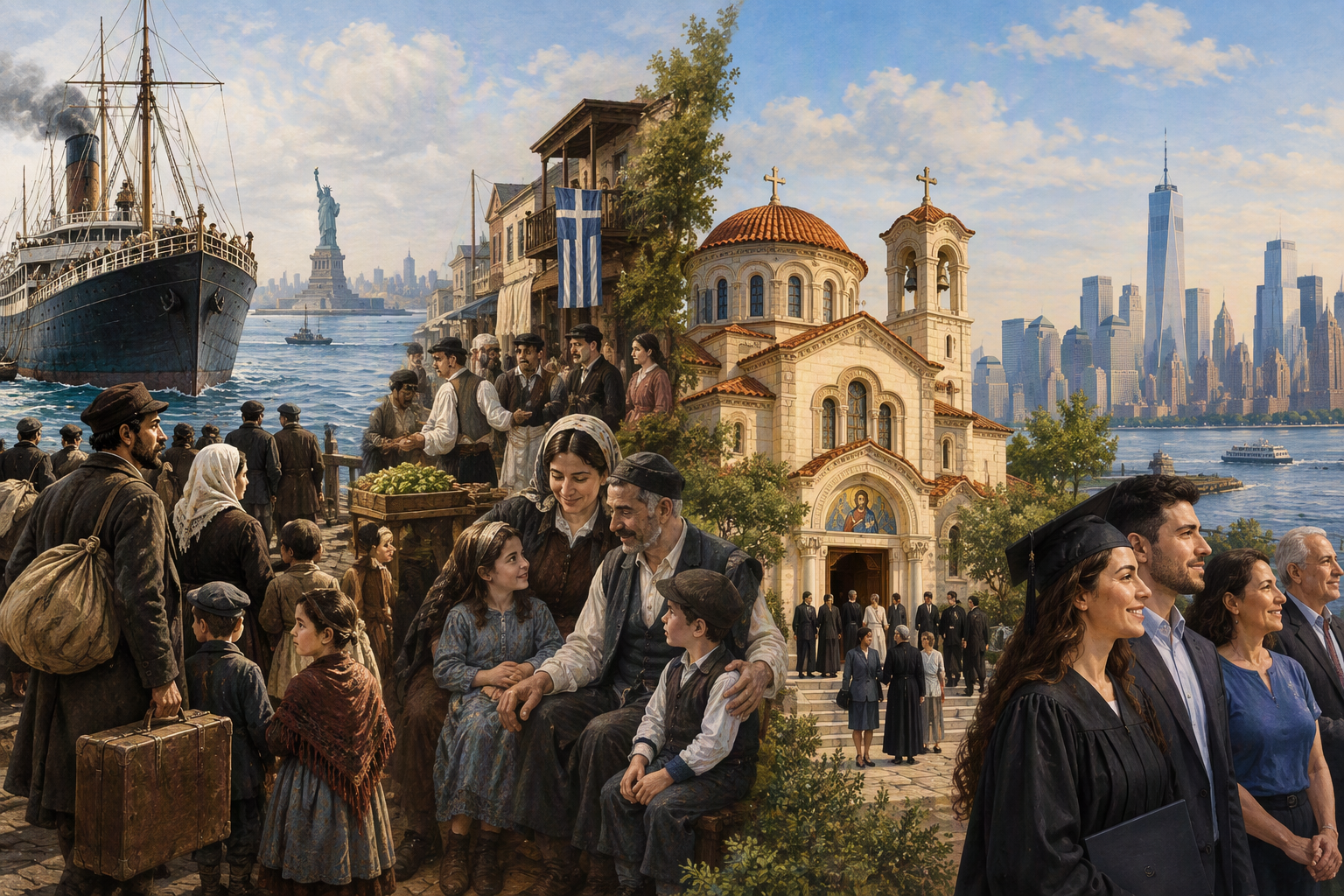
How Many Greeks Live in America? The Greek-American Population Since 1840
How many Greeks live in the United States? The answer depends on what we mean by “Greek.” Do we mean people born in Greece, people who report Greek ancestry, people who speak Greek at home, or Americans who identify with Greek culture several generations after their ancestors arrived?
Those categories are different, and they cannot be added together without creating a misleading picture. A Greek-born immigrant is counted differently from a second- or third-generation Greek American. Historical records also changed over time, which makes it difficult to create one perfectly consistent population series beginning in 1840.
The First Greek Arrivals Before Mass Immigration
During the first half of the nineteenth century, the Greek presence in the United States was small and difficult to measure. Individual sailors, merchants, students, religious figures, and political exiles arrived through different routes. Some stayed permanently, while others moved on or returned to Greece.
Because these early arrivals were few and dispersed, they were not always recorded as a distinct Greek community. The modern idea of a Greek-American population developed later, when larger numbers of immigrants arrived from the Greek kingdom, the Ottoman-ruled Greek world, and Greek islands.
1880 to 1914: The First Large Growth
Greek immigration expanded significantly in the late nineteenth and early twentieth centuries. Economic pressure, limited employment opportunities, rural poverty, and the hope of earning money in the United States encouraged many young men to leave Greece and surrounding Greek-speaking regions.
Many newcomers followed chain-migration patterns. One person would settle in an American city, find work, and then help relatives or neighbors make the journey. This process created Greek neighborhoods and business networks in cities such as New York, Chicago, Boston, Lowell, Detroit, Philadelphia, and Cleveland.
Restaurants, coffeehouses, grocery stores, confectioneries, and small manufacturing businesses became important entry points into American economic life. Greek Orthodox churches and mutual-aid societies soon gave these growing communities religious, social, and practical support.
Why Historical Population Numbers Differ
Modern readers often look for one number that represents all Greeks in America. Historical research requires more care. A census may count people born in Greece, while another source may count people who identified Greek as their ancestry. A person born in the United States to Greek parents may appear in an ancestry count but not in an immigrant count.
The American Community Survey continues to collect ancestry information, but ancestry is self-reported and can include people with more than one background. It therefore measures identity and family heritage, not simply immigration. For earlier periods, researchers often rely on census birthplace data, immigration records, church records, newspaper reports, and community histories.
1915 to 1924: War and Immigration Restrictions
World War I and political changes in the eastern Mediterranean affected Greek migration. At the same time, the United States began to impose stronger restrictions on immigration. The Emergency Quota Act of 1921 and the Johnson-Reed Act of 1924 sharply limited immigration through national-origins quotas.
These laws changed the shape of Greek America. The era of large-scale arrival became more restricted, while the communities already established in the United States became more family-centered and institutionally organized.
1925 to 1945: From Immigrant Communities to American Institutions
During the interwar years, Greek Americans built lasting institutions. Parishes, schools, newspapers, benefit societies, professional organizations, and cultural associations helped preserve language and traditions while supporting participation in American civic life.
The Great Depression created hardship for many families, especially those working in small businesses, restaurants, manufacturing, and service industries. Yet the same community networks that had helped immigrants settle also provided assistance during difficult years.
1945 to 1965: Postwar Growth and New Arrivals
After World War II, new groups arrived through changing refugee and immigration programs. Some were displaced by war and political upheaval. Others came through family reunification or professional opportunities. These arrivals joined communities that were already several decades old.
By the middle of the twentieth century, Greek America was no longer only an immigrant population. It included children and grandchildren of earlier arrivals, bilingual families, American-born professionals, business owners, clergy, educators, and community leaders.
How Many Greek Americans Are There Today?
There is no single perfect number because the answer changes with the definition. A foreign-born estimate measures people born in Greece who live in the United States. An ancestry estimate includes American-born descendants and people who identify with Greek heritage. A language measure captures another part of the community.
The most responsible answer is therefore a range accompanied by a definition. Researchers and readers should always ask whether a number refers to Greek birthplace, Greek ancestry, Greek language use, or broader cultural identity.
A Community Measured by More Than Numbers
The history of Greeks in America is not only a population story. It is also the story of family networks, churches, neighborhoods, food, education, business, philanthropy, and cultural memory. From a small and scattered presence in the nineteenth century, Greek Americans developed a nationwide community with deep roots in both Greece and the United States.
Sources and Further Reading
- U.S. Census Bureau, American Community Survey data and ancestry documentation.
- Library of Congress collections on Greek immigration and Greek-American communities.
- Immigration History, historical documents on U.S. immigration laws and quota systems.
How did your family become part of Greek America? Share your family’s region of origin, arrival decade, and American hometown with the Greek-American community.